4th–3rd centuries BCE to 12th–13th centuries CE; flourishing in the 6th–8th centuries
Varakhsha — Residence of the Bukhar Khudats
West of Bukhara, Varakhsha was a fortified centre and residence of the Bukhar Khudats. Its painted palace, trade routes and irrigation history illuminate the world of Bukhara Sogd.
- Location
- 40–45 km west of Bukhara, Uzbekistan
- Flourishing
- 6th–8th centuries CE
- Heritage
- Bukhar Khudat palace, murals and carved stucco
- Status
- UNESCO Tentative List since 2008
Varakhsha on the western edge of the Bukhara oasis
Varakhsha is an ancient archaeological site about 40–45 kilometres west of Bukhara in present-day Uzbekistan. Its surviving earthworks and palace ruins were once part of an important centre of Bukhara Sogd. Varakhsha is best known for the remarkable murals and carved stucco decoration of the palace associated with the Bukhar Khudats, the region’s local rulers.
Its history is reconstructed through archaeological evidence and medieval texts. A particularly valuable account is Muhammad Narshakhi’s tenth-century History of Bukhara, which preserves traditions concerning the settlement, its rulers and its markets.
Origins and urban layout
According to the description submitted to UNESCO’s Tentative List, settlement at Varakhsha dates back to the fourth–third centuries BCE. A fortified settlement developed in subsequent centuries, sustained by irrigated agriculture in the western Bukhara oasis.
The site comprised a citadel, a walled town or shahristan, and adjacent areas associated with trade and crafts. Builders used mud brick extensively. The surviving earthen ramparts and walls attest to a substantial defensive system, although the present landscape cannot fully reproduce the medieval townscape.
The Bukhar Khudats and their residence
The Bukhar Khudats were a local ruling dynasty of the Bukhara oasis before and during the establishment of Arab authority. In the sixth to eighth centuries, Varakhsha served as one of their important residences. This does not mean that all regional administration was permanently based there: Bukhara and Varakhsha played related but distinct roles.
Its fortified position on the western side of the oasis gave access to lands and routes linking Bukhara with Khwarazm. Medieval geographical accounts refer to the area’s commercial significance. Narshakhi also described markets at Varakhsha, suggesting that the royal residence was a centre of economic exchange as well as political power.
The palace: Red, Eastern and Western halls
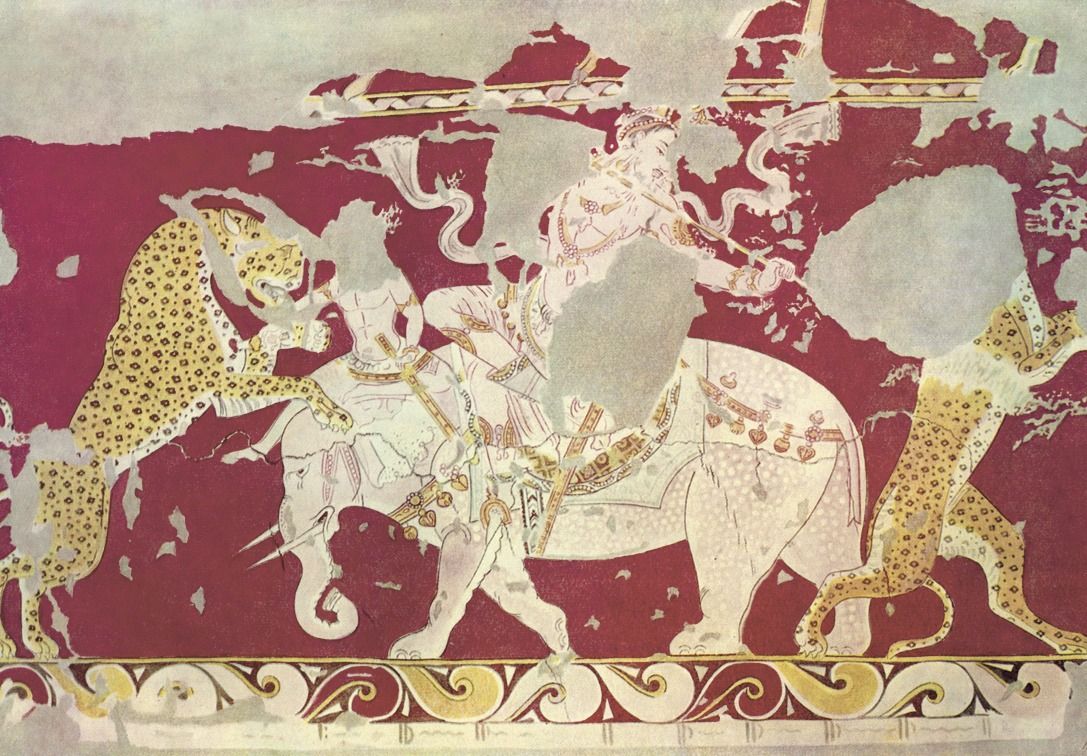
The palace developed through several phases of construction and renovation. Archaeologists have studied rooms conventionally known as the Red, Eastern (Blue) and Western halls. Their walls once carried elaborate figural paintings, while other parts of the complex were embellished with carved stucco, known locally as ganch.
The best-known compositions from the Red Hall show figures mounted on elephants confronting predators and fantastic creatures. Their vivid red grounds and energetic forms are among the most striking survivals of Sogdian monumental painting. The Eastern Hall included ceremonial or possibly dynastic imagery, notably a seated figure on a throne. Scholars have proposed connections with royal ideology and religious beliefs, but the precise identification of individual figures remains debated.
The murals are generally dated to the seventh–eighth centuries; some more recent studies place the Red Hall decoration in the 730s CE. They should therefore not be read as straightforward illustrations of a single recorded historical event.
The gradual decline of Varakhsha
Life in the western Bukhara oasis depended on canals fed by the Zarafshan river system. Changes in watercourses and irrigation reduced agricultural potential and weakened settlements. Political upheavals and shifts in regional centres of power added to these pressures.
Varakhsha was not abandoned in a single clearly dated event. Some studies place the end of urban life in the second half of the twelfth century; the UNESCO Tentative List description also associates later destruction with the Mongol conquest in the thirteenth century. Taken together, these accounts suggest a prolonged decline rather than a single sudden catastrophe.
Excavations and cultural significance
Major excavations of the palace led by archaeologist Vasily Shishkin took place in 1937–1939 and again from the late 1940s into the first half of the 1950s. The discoveries established Varakhsha as a key monument for the study of Sogdian wall painting. Fragments of its painted and carved decoration are held in museums and require careful conservation.
Beyond its association with the Bukhar Khudats, Varakhsha provides evidence for early medieval urban planning, defence, economic life and artistic traditions in the Bukhara oasis. The site was placed on Uzbekistan’s UNESCO World Heritage Tentative List in 2008; it is not thereby inscribed on the World Heritage List itself.
Sources
- UNESCO World Heritage Centre. Varakhsha, Tentative List (2008).
- T. I. Gyul. On the dynastic cult of the rulers of Bukhara Sogd (2021).
- Ciro Lo Muzio. The “Red Hall” murals in the Varakhsha Palace (2023).
- World Society for the Study, Preservation and Popularization of the Cultural Legacy of Uzbekistan. Palace beauties in the old city (2023).
- Bukhara Museum. Archaeological collection: Varakhsha.
- Encyclopaedia Iranica. Archeology V. Pre-Islamic.