From the 4th century BCE to the Middle Ages
Uzbekistan’s Forgotten Ancient Cities: 8 Historical Sites
Poykent, Varakhsha, Akhsikent, Qanqa, Dalverzintepa, Mingtepa, Kuva, and Kampirtepa: the lesser-known ancient cities of Uzbekistan, their trade routes, and archaeological heritage.
- Region
- Bukhara, Tashkent, Namangan, Andijan, Fergana, and Surkhandarya Regions
- Number of cities
- 8
- Main themes
- Ancient urban planning, trade, religion, craftsmanship, and archaeology
Introduction
Beyond Samarkand, Bukhara, and Khiva, many other ancient cities once existed in the territory of Uzbekistan. Some survive today as ruins or archaeological sites.
This article brings together eight historic cities: Poykent, Varakhsha, Akhsikent, Qanqa, Dalverzintepa, Mingtepa, Kuva, and Kampirtepa. Each has its own history of trade, politics, religion, and craftsmanship.
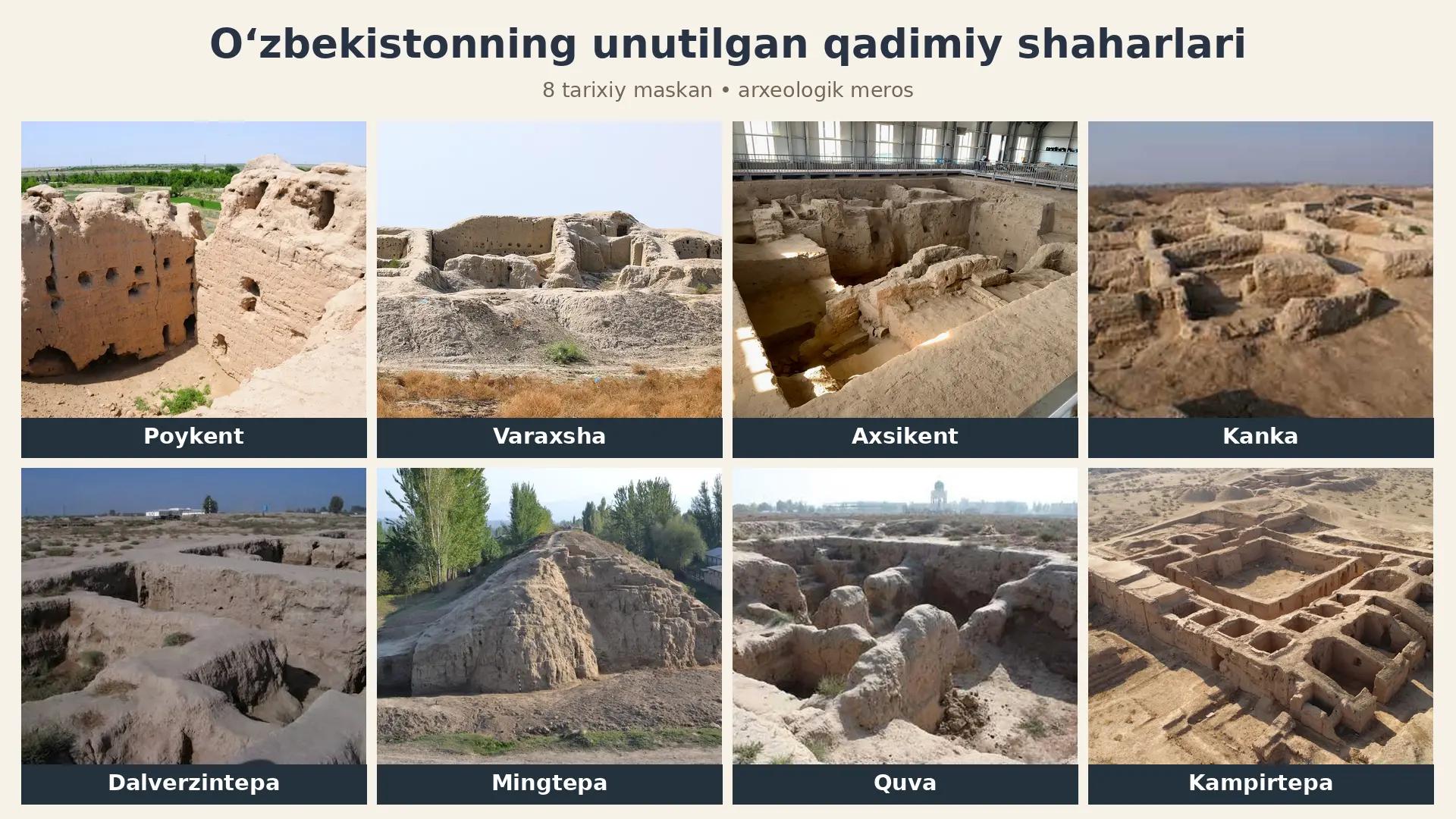
Poykent — City of Merchants
Poykent, in Bukhara Region, Poykent Zarafshon quyi oqimida joylashgan. Miloddan avvalgi IV asrda shakllangan manzilgoh keyinchalik qal’a, shahristonlar va raboddan iborat yirik savdo markaziga aylangan.
Situated at the crossroads of caravan routes, Poykent developed its crafts, markets, and trade. Its ruins help researchers study the ancient economic life of the Bukhara Oasis.
Varakhsha — Residence of the Bukhar Khudats
Varakhsha, west of Bukhara, is one of the ancient Sogdian cities. Medieval written sources mention it as the residence of the Bukhar Khudat dynasty.
The palace murals and decorations are among Varakhsha’s most important discoveries. Changes in the water supply and political events contributed to the city’s decline.
Akhsikent — Craft Center of Fergana
Akhsikent, on the right bank of the Syr Darya in Namangan Region, was one of the important cities of ancient and medieval Fergana.
Remains of a fortress, shahristan, rabat, market, and workshops show that urban life flourished here. The city was especially known for its metalworking traditions.
Qanqa — Ancient Center of the Tashkent Oasis
Qanqa, in Tashkent Region, is the site of a large fortified city. Archaeologists have identified a citadel, several shahristans, and commercial and craft districts.
Defensive walls, religious buildings, and workshops from different periods shed light on the long history of urban development in the Chach Oasis.
Dalverzintepa — A City of the Kushan Period
Dalverzintepa, in Surkhandarya Region, is an important archaeological monument of the Kushan period. Residential buildings, religious structures, and traces of craftsmanship have been discovered there.
The remains of a Buddhist temple and works of art show that Northern Bactria had strong cultural and religious connections.
Mingtepa — An Ancient City of Fergana
Mingtepa, in Andijan Region, is the ruin of a large ancient city. It is widely associated with the city of Ershi in the state of Dayuan mentioned in Chinese chronicles, although this historical identification requires scholarly caution.
The fortifications and the city’s large area show that a complex urban culture had already developed in the Fergana Valley in antiquity.
Kuva — Crossroads of Religions and Cultures
Kuva, in Fergana Region, was an important city in ancient and medieval times. The remains of a Buddhist temple dating to the 7th–8th centuries have been studied here.
These finds indicate that different religious traditions coexisted in the Fergana Valley before the arrival of Islam.
Kampirtepa — A Fortress City on the Amu Darya
Kampirtepa, near the Amu Darya in Surkhandarya Region, served defensive and commercial functions in antiquity. The Hellenistic and Kushan periods occupy a special place in its history.
The fortress, dwellings, coins, and inscribed artifacts are important for studying river connections and interregional trade. Its identification with Alexandria Oxiana should be presented as a scholarly interpretation.
What Unites These Cities?
These settlements developed along river valleys, irrigated oases, and caravan routes. Water, trade, craftsmanship, and defensive systems played major roles in their development.
The cities did not all share the same fate: some lost their standing as political centers, while others declined because of shifting waterways, wars, or changes in economic routes.
Archaeology and Historical Memory
Walls, coins, pottery, religious images, and inscriptions found in archaeological excavations help reconstruct life in ancient cities.
The dates of these monuments and their identification with ancient place names are not always certain. Historical maps and reconstructions should therefore be presented as approximate.
Conclusion
The eight cities from Poykent to Kampirtepa offer a combined view of different periods of Uzbekistan’s history. They connect the histories of the Silk Road, ancient Bactria, Chach, Sogdia, and Fergana.
Studying these sites is not just about remembering lost cities but also about understanding the region’s ancient cultural diversity.
Sources
- UNESCO World Heritage Centre. Silk Roads Sites in Uzbekistan (Tentative List).
- UNESCO World Heritage Centre. Silk Roads: Fergana–Syr Darya Corridor (Tentative List).
- Uzbekistan Travel. Ancient Cities of Uzbekistan — Paykend and Varakhsha.
- Uzbekistan Travel. Ancient City of Akhsikent.
- Uzbekistan Travel. Dalverzintepa.
- Uzbekistan Travel. Kampirtepa.