Antiquity — 21st century
Tashkent: Chach, Binkat and the modern city
Tashkent's history embraces an ancient oasis, medieval towns, imperial conquest, Soviet reconstruction and the conservation of modernist architecture.
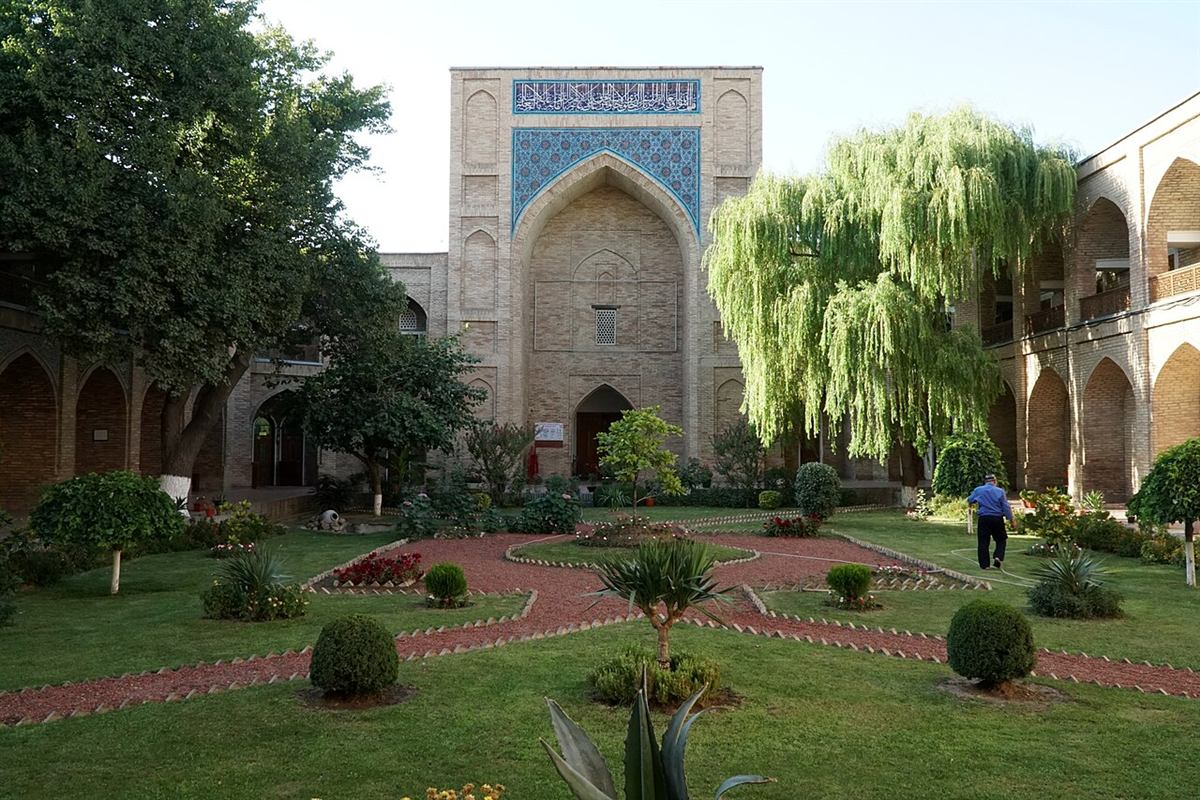
- Historic region
- Chach / Shash in the Chirchiq and Akhangaran basins
- Medieval town
- Binkat is distinct from nearby Banakat
- Modern heritage
- A Tashkent modernism ensemble joined UNESCO's World Heritage List in 2026
The Chach oasis
Tashkent developed in an oasis connected to the Chirchiq, Akhangaran and middle Syr Darya. In ancient and medieval sources, Chach or Shash could mean a region rather than a point at the modern city centre. Farmland, settlements, pastures and roads to the steppe and Fergana formed one historical system.
Ilaq to the south was a region of mines, metallurgy and towns. Evidence for gold, silver and other metals helps explain an economy that cannot be reduced to caravan transit. Shifting centres and changing names make it misleading to treat today's municipal boundary as ancient Chach's border.
Binkat, Shash and neighbouring towns
Medieval Binkat was Shash's principal town. Archaeology reveals a complex urban structure with a fortified core and suburbs containing markets and workshops. Coins, geographical works and archaeological layers must be read together: a name on a coin may designate a district or mint, not a permanently fixed city.
Banakat was a different town near the meeting of the Syr Darya and Akhangaran, and should not be confused with Binkat. Encyclopaedia Iranica also traces the changing use of “Tashkent” in medieval sources. There is no simple straight line from every old place-name to a present-day street.
From khanates to imperial centre
In the early modern period Tashkent was contested by local authorities and neighbouring states, including the Kokand Khanate. Its political and commercial role attracted the Russian Empire in the nineteenth century. General Chernyaev's forces took the city in 1865; formal annexation was proclaimed in 1866.
Conquest involved violence, resistance and negotiation among different urban groups. New administrative and residential districts then grew alongside the old city. Yet “European” and “old” areas were not separate worlds: labour, trade, water and infrastructure connected them.
Capital and earthquake
Tashkent became the capital of the Uzbek SSR in 1930. Universities, scientific institutions, industry and transport were reshaping it even before the earthquake of 26 April 1966. The earthquake was a turning point, not the beginning of the city's modern history.
Reconstruction accelerated the creation of new neighbourhoods, major civic buildings and green spaces. Architects and engineers joined standardised construction to climate-sensitive courtyards, loggias, sun shading and decorative motifs. The rebuilding also altered older quarters and residents' daily lives; it should not be told solely as an architectural success.
Modernism as heritage
In 2026 UNESCO inscribed the serial property “Tashkent Modernist Architecture. Modernity and Tradition in Central Asia” on the World Heritage List. It comprises ten buildings and urban ensembles dating from the 1960s to the early 1990s, not the entire city or every Soviet-era building.
The Committee highlighted seismic engineering, adaptation to climate, monumental art and the buildings' relationship to urban views. Conserving this heritage means protecting its setting as well as façades. Earlier Tashkent also needs study and care: archaeological sites, neighbourhoods and buildings from khanate and imperial periods.
