14th–15th centuries
Samarkand under the Timurids
Under Amir Timur and his successors, Samarkand became an imperial capital and a centre of architecture and science.
- Capital
- Samarkand from 1370
- Rulers
- Amir Timur, Shah Rukh, Ulugh Beg
- Legacy
- Gur-e Amir, Bibi-Khanym, Shah-i-Zinda, Ulugh Beg Madrasa
Making a capital
Amir Timur made Samarkand his capital in 1370. The city was rebuilt as a display of power, drawing resources, craftspeople and artistic traditions from across the empire.
Monumental construction cannot be separated from conquest and the forced movement of artisans. Architectural splendour formed part of a political project.
Samarkand benefited from its position in the fertile Zeravshan valley and from long-established commercial and craft traditions. Long before Timur, the city had links with Transoxiana, Khurasan, the steppe and routes extending towards China. The new imperial capital drew on this deep history while projecting the ambitions of its ruler.
Capital status involved more than palaces and mosques. Administrators directed resources, envoys attended court, and commanders, scholars, merchants and craftspeople moved through the city. Ceremonies, gardens and ambitious construction works made political power visible to both residents and foreign visitors.
This cultural flourishing was inseparable from warfare and unequal control over resources. While patronage attracted some specialists, others were forcibly relocated from conquered regions. The city’s architectural achievements therefore need to be considered alongside the experiences of the people whose labour made them possible.
City and monuments
The Bibi-Khanym Mosque, Gur-e Amir and Shah-i-Zinda ensembles reshaped the city. Brick construction was combined with tilework, mosaic, carved terracotta and calligraphy.
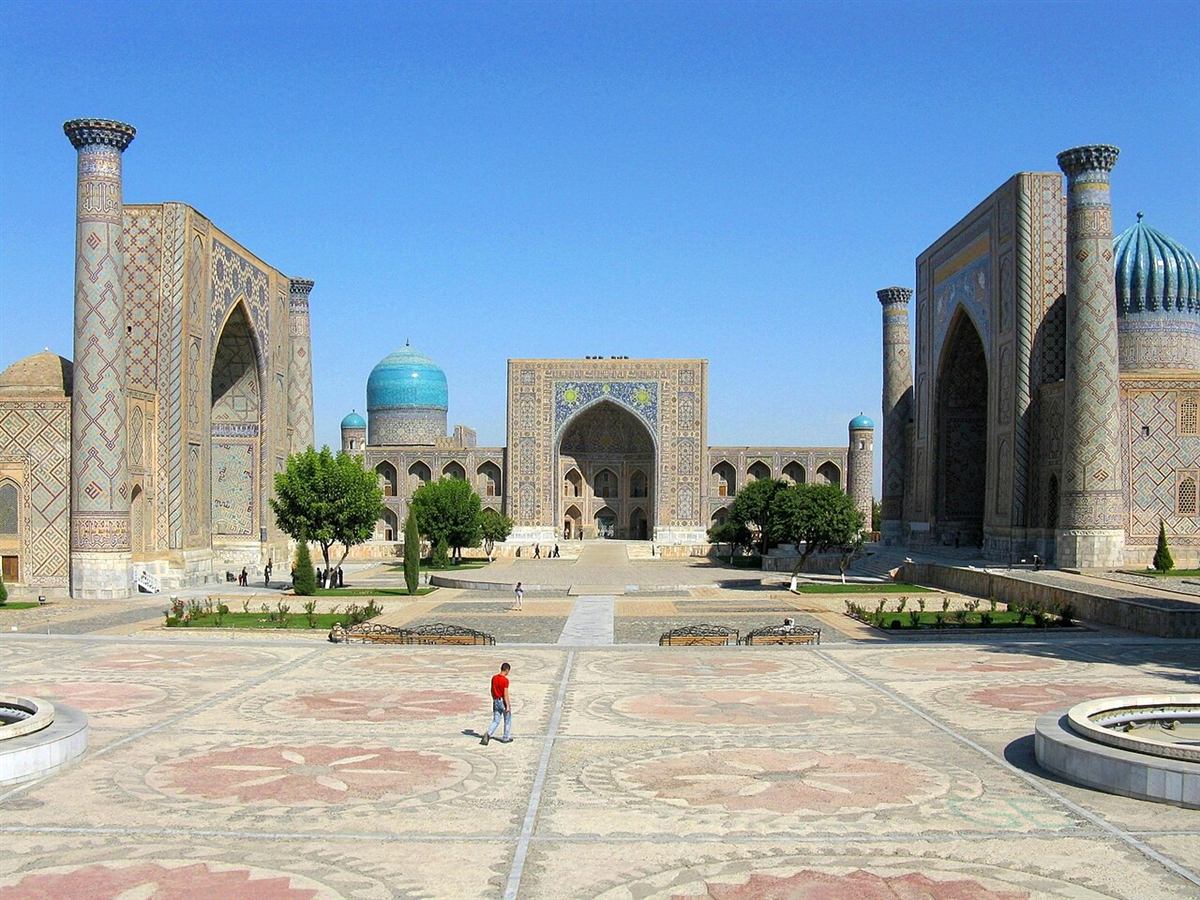
Today’s Registan developed over centuries. Ulugh Beg’s madrasa is Timurid; Sher-Dor and Tilla-Kari were built in the seventeenth century.
Timurid architecture favoured monumental portals, imposing domes, carefully arranged courtyards and brilliant ceramic surfaces. A tall entrance portal, or pishtaq, structured the view into a building. Glazed bricks, tile mosaic, geometric patterns, vegetal ornament and calligraphy turned structural surfaces into sophisticated visual compositions.
The Bibi-Khanym Mosque, constructed around the turn of the fifteenth century, expressed Timur’s ambition on an exceptional scale. Yet its size and structural challenges contributed to later damage. What visitors see today reflects the original project, historical deterioration and modern conservation and reconstruction.
Gur-e Amir developed in the early fifteenth century and became the burial place of Timur and several dynastic relatives. Its ribbed turquoise dome and richly decorated interior communicate the importance of dynastic memory. Shah-i-Zinda is a different kind of monument: an evolving group of mausoleums that vividly preserves several approaches to ceramic ornament.
Ulugh Beg and astronomy
Ulugh Beg combined rule with a sustained interest in mathematics and astronomy. His observatory used a monumental sextant for precise observations.
The scholarly environment extended beyond one ruler. Madrasas, libraries and connections with other centres enabled the movement of scholars and texts.
During the first half of the fifteenth century, Samarkand became renowned for mathematical and astronomical scholarship associated with Ulugh Beg. He was an active participant in intellectual culture as well as a patron. His projects demonstrate how a courtly centre could also provide an institutional setting for systematic scientific inquiry.
Ulugh Beg’s observatory, built in the 1420s, housed a huge fixed angular measuring instrument, part of which extended below ground level. Astronomers used precise geometry and repeated observations of celestial positions. The device was not a telescope in the modern sense; observational astronomy relied primarily on naked-eye measurements.
Qadi Zada al-Rumi, Jamshid al-Kashi and Ali Qushji were among the notable scholars linked to this environment. Work on mathematics, numerical methods and astronomy formed part of a much wider scholarly tradition. The Zij-i Sultani, a set of astronomical tables and a star catalogue produced in Ulugh Beg’s circle, circulated beyond Central Asia.
Legacy and conservation
UNESCO describes Samarkand as a crossroads of cultures with more than two and a half millennia of history. The Timurid layer is only one, though highly visible, phase.
Protecting a living historic city requires a balance between conservation, modern development and neighbourhood life.
In 2001 UNESCO inscribed “Samarkand – Crossroad of Cultures” on the World Heritage List. The designation concerns a layered historic urban landscape rather than a single building or solely the Timurid period: ancient Afrasiab, medieval ensembles, traditional neighbourhoods and later areas all contribute to its significance.
Conservation involves difficult choices about earthquakes, moisture, salts, tourism, urban development and the quality of restoration. A surface may look medieval even where sections of its decoration have been reconstructed in modern times. Distinguishing original fabric from later additions and interventions is essential to an informed understanding of the monuments.
Living heritage also includes courtyard housing, neighbourhood structures, inherited skills and local memories. Protecting Samarkand means balancing architectural research with the needs of residents, accessible public space and careful infrastructure planning.
Before the Timurid capital
Samarkand’s history long predates the Timurids. The archaeological site of Afrasiab, northeast of the modern city centre, preserves traces of earlier settlement. Its position in the Zeravshan oasis connected agricultural production with long-distance trade. Political regimes, religious communities and artistic traditions changed repeatedly over the centuries.
The Mongol conquest in the early thirteenth century dealt a major blow to the older urban centre. Urban life subsequently developed farther south of ancient Afrasiab. Timur’s construction programme thus transformed an already inhabited and historically complex landscape rather than creating a city from nothing.
Samarkand was a meeting point of languages, beliefs, art forms and economic networks. People arrived through commerce, study, diplomacy and sometimes coercion. This helps explain why its monuments combine recognisably Central Asian features with influences from other regions.
Court, government and diplomacy
The imperial court was a centre for political decisions and diplomatic display. Campaigns, appointments, revenue assignments and relations with foreign rulers were discussed in this environment. Envoys encountered ceremonies, gift exchanges and carefully staged displays of wealth. Travel accounts offer valuable, though selective, outside perspectives on the capital.
Administration depended on relationships among the ruler, military elites, officials and local power holders. Actual authority differed across the empire, so it is misleading to imagine a uniform modern bureaucracy. After Timur’s death in 1405, succession struggles changed the political balance within the dynasty.
Under Shah Rukh, Herat became a major political centre, while Samarkand remained an important dynastic and intellectual city. Ulugh Beg governed Transoxiana and supported scholarship and building in Samarkand. The city’s role therefore changed during the fifteenth century rather than remaining the sole capital of an unchanged empire.
Markets, commerce and resources
Samarkand’s economy connected irrigated agriculture, urban crafts and long-distance exchange. Farms in the Zeravshan valley supplied food and materials, while bazaars traded textiles, metalwork, ceramics, provisions and luxury items. The fortunes of merchants depended on road security, taxation and relations with surrounding territories.
The term “Silk Roads” describes an evolving network rather than one fixed highway. Goods often passed through several intermediaries before reaching Samarkand; the presence of imported objects does not always prove direct contact with their place of origin.
Workshops, storage areas, transport services and markets supported daily commerce. Artisans served patrons ranging from the court to religious foundations and ordinary households. Major commissions stimulated some crafts, but their costs were not shared equally, and monumental construction could impose burdens on the wider population.
Craftsmanship and visual culture
Samarkand’s blue and turquoise monuments testify to the expertise of potters, tile cutters, builders and designers. Glazed brick and ceramic mosaic had both structural and decorative roles. Decorating curved domes, niches and vaults required particular skill in adapting patterns to complex surfaces.
Architectural inscriptions served religious, commemorative and aesthetic purposes. Calligraphy was integrated with interlocking geometry and vegetal ornament. Workshop practices developed across generations, while patterns travelled with craftspeople, drawings and shared techniques.
Other branches of production included textiles, metalworking, carpentry, bookmaking and everyday household goods. The surviving record is uneven: monumental architecture tends to outlast fragile objects. Archaeologists and historians therefore combine excavated evidence, written descriptions and surviving works of art.
Madrasas, manuscripts and learning
A madrasa was an educational institution whose curriculum and organisation varied by setting. In Samarkand, religious studies interacted with logic, mathematics and other branches of learning. Teaching relied on manuscripts, commentary, debate and close relationships between scholars and students.
Ulugh Beg’s madrasa on Registan Square, erected in the first quarter of the fifteenth century, became a celebrated symbol of scholarship. Its magnificent architecture should not be mistaken for evidence of one fixed curriculum. Intellectual life must also be reconstructed from scholarly writings and the movement of texts.
Networks linked Samarkand with Herat, Bukhara and other centres. Scholars travelled, copied and commented on earlier works and refined methods of calculation. The achievements associated with Ulugh Beg were therefore collective accomplishments within a broad intellectual tradition.
Everyday life and neighbourhoods
Behind monumental entrances lay courtyards, lanes, local mosques, workshops and neighbourhood markets. Courtyard houses offered privacy and helped manage the region’s hot summers. Everyday routines were shaped by the agricultural seasons, religious observances, commerce and family life.
Urban society included elite households, officials, scholars, traders, craftsmen, agricultural workers and people of dependent status. Written sources describe rulers much more fully than ordinary residents. Claims about food, clothing and domestic life should consequently be checked against archaeology and comparable evidence.
The mahalla provides a useful way to describe the social geography of traditional neighbourhoods, although today’s institutions should not simply be projected unchanged onto the fifteenth century. Small communal centres, paths and water systems are part of the historic city’s significance.
A timeline of major developments
The year 1370 marks the conventional beginning of Timur’s rule and Samarkand’s rise as the centre of his realm. Court-sponsored buildings and workshops expanded in subsequent decades. Construction of the Bibi-Khanym Mosque took place around the turn of the fourteenth and fifteenth centuries.
In 1404 the Castilian envoy Ruy González de Clavijo visited Samarkand; his account remains a valuable witness to court life. Timur died in 1405, and disputes over succession reshaped dynastic politics. In the first half of the fifteenth century Ulugh Beg became closely associated with the city.
Ulugh Beg’s madrasa dates to approximately 1417–1420, and the observatory to the 1420s. He died in 1449 amid dynastic conflict. Registan Square continued to evolve: the Sher-Dor and Tilla-Kari madrasas were built only in the seventeenth century and should not be labelled Timurid buildings.
A wider historical legacy
Timurid buildings in Samarkand were influential in the wider history of Islamic architecture. Their arrangements, ceramic decoration and sense of scale resonated across regions. UNESCO highlights connections between Timurid achievements and later Safavid and Mughal architectural traditions.
Samarkand’s scientific history is equally important as an example of precision measurement, computation and scholarly exchange. Knowledge travelled through manuscripts, teachers, journeys and commentary. The surviving buildings allow visitors to encounter the physical settings in which parts of this intellectual culture developed.
The city is best appreciated not as a perfectly preserved golden age but as a place of continuous transformation. Its history brings together artistic and scientific achievement, political conflict, the labour of artisans and the ongoing responsibilities of conservation.