1st–3rd centuries CE (period of greatest power)
Kushan Empire: History and Legacy
How the Kushan Empire connected Bactria, Afghanistan and northern India, fostered trade and Buddhist culture, and left its mark on ancient Termez through Fayaztepa, Karatepa and the Zurmala stupa.
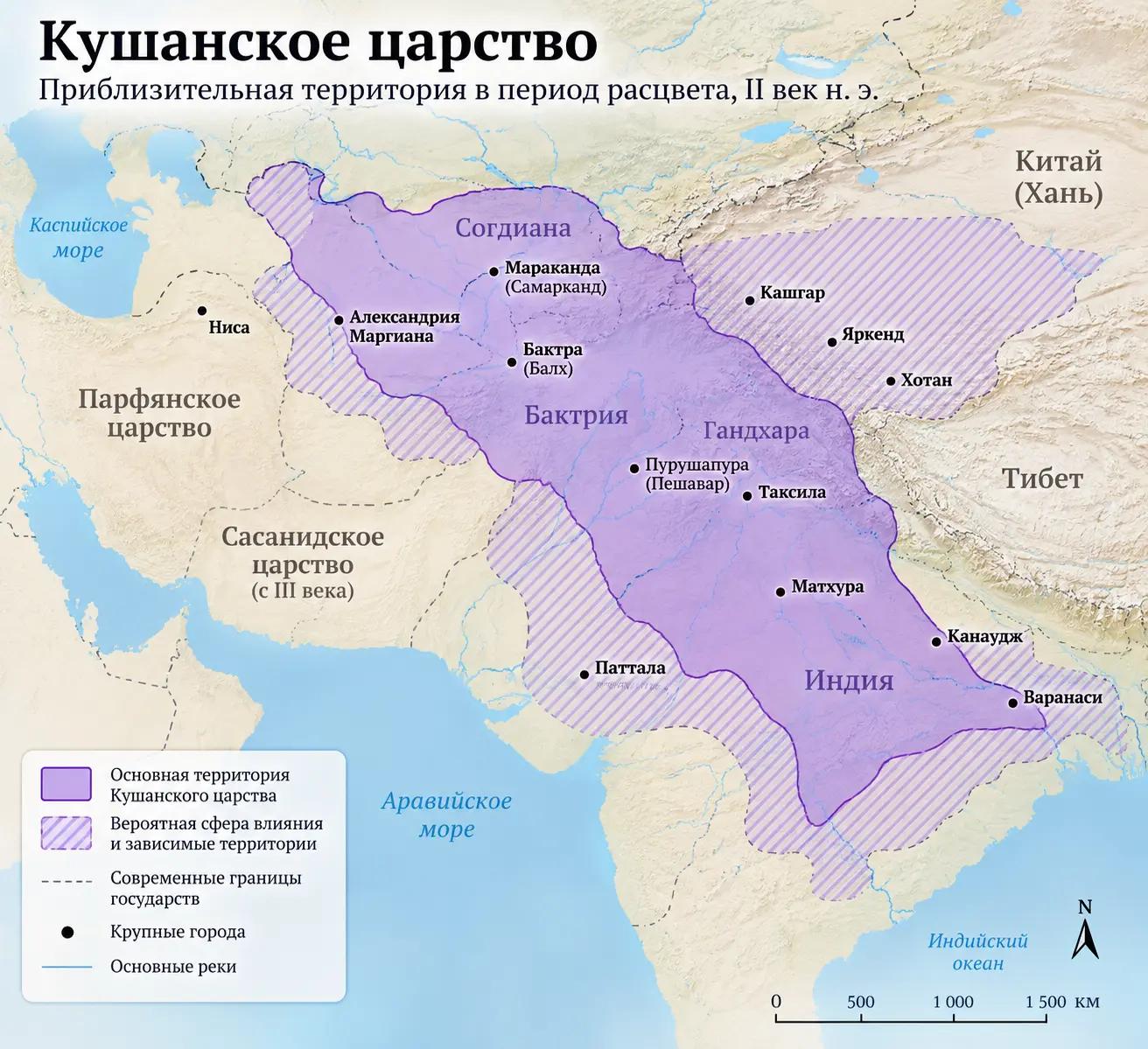
- Period
- 1st–3rd centuries CE; later Kushan dynastic traditions survived beyond this period
- Main territories
- Bactria, present-day Afghanistan, Pakistan and northern India; at times, neighboring parts of Central Asia
- Dynastic origins
- The Kushans were a branch of the Yuezhi confederation that migrated into Bactria
- Notable rulers
- Kujula Kadphises, Vima Kadphises, Kanishka I, Huvishka, Vasudeva I
- Monuments in Uzbekistan
- Ancient Termez, Fayaztepa, Karatepa, Zurmala stupa, Dalverzintepa
- Sources
- Chinese historical accounts, inscriptions, coins and archaeological finds
Introduction
The Kushan Empire was one of the largest states in Central and South Asia during the first centuries of the Common Era. Its rulers controlled territories on both sides of the Hindu Kush, connecting Bactria, the Kabul Valley, Gandhara and parts of northern India. Iranian, Hellenistic and Indian cultural traditions met across these lands.
Northern Bactria, particularly ancient Termez and the archaeological sites of Surkhandarya Region, is especially important to the history of present-day Uzbekistan. Evidence of urban life, commerce and Buddhist monasteries from the Kushan period survives here.
Origins of the Kushans
The origins of the Kushan dynasty are associated with the Yuezhi, a confederation of groups known from Chinese historical writings. Following migrations from eastern Central Asia, the Yuezhi established themselves in Bactria. The name “Kushan” is generally linked to one of their political groups, rendered as Guishuang in Chinese sources.
In the 1st century CE, Kujula Kadphises united a substantial part of the Yuezhi domains and laid the foundations of a new empire. The precise dates of early reigns and stages of territorial expansion remain debated: written evidence is fragmentary, and coins play a central role in reconstructing this history.
Formation and Expansion of the Empire
Under the earliest Kushan rulers, a political center emerged in Bactria and neighboring territories. Dynastic power gradually extended across the Hindu Kush into Gandhara and northwestern India. Vima Kadphises is generally associated with further consolidation of the empire and the development of gold coinage.
The Kushan state never had fixed borders: its territory and the degree of control over individual regions changed over time. Maps of the “Kushan Empire” should therefore be understood as reconstructions for particular periods rather than exact depictions of a permanent frontier.
Kanishka I and the Height of Kushan Power
Kanishka I is the best-known Kushan ruler. His reign is generally placed in the 2nd century CE; the beginning of the Kushan era is often dated to 127 CE, but this date should not automatically be treated as the exact year of Kanishka’s accession.
Under Kanishka, major centers in Gandhara and northern India gained importance, while coins and inscriptions attest to an elaborate ideology of kingship. He is widely known as a patron of Buddhism, yet his coins also depict deities from several religious traditions. This reflects the empire’s cultural diversity, not the exclusive adherence of all its inhabitants to one religion.
Rulers and Chronology
The most important rulers include Kujula Kadphises, Vima Kadphises, Kanishka I, Huvishka and Vasudeva I. Their sequence is reconstructed from coin series and epigraphic evidence; some reign dates are approximate.
The empire continued under Huvishka and Vasudeva I after Kanishka’s reign. In the 3rd century, Sasanian pressure changed the position of Kushan rulers in Bactria. Kushan and Kushano-Sasanian political formations should not, however, be treated as the same state without qualification.
Bactria and Ancient Termez
Bactria extended across both banks of the Amu Darya. During the Kushan period, northern Bactrian cities formed part of a network of trade and cultural contacts linking Central Asia, Afghanistan and India. Ancient Termez, situated near an important river crossing, held a notable place in this network.
Archaeological research at Termez has revealed urban structures and Buddhist complexes. Fayaztepa and Karatepa illuminate not only religious practices but also architecture, artistic crafts and the everyday life of communities. When discussing particular finds, ancient Termez should be distinguished from the modern city.
Buddhism and Religious Diversity
Buddhism spread widely in several regions of the Kushan Empire. Monastic centers were supported by donations and maintained links with trade routes. At the same time, the empire’s inhabitants practiced different faiths: its coins depict Iranian, Indian and other deities.
The spread of Buddhism cannot be attributed solely to one king. It was a long process involving monastic communities, merchants and local patrons. Evidence from Termez shows that northern Bactria was an important center of Buddhist culture in the first centuries CE.
Buddhist Monuments of Surkhandarya
Fayaztepa is a monastic complex near ancient Termez whose flourishing UNESCO dates to the 1st–3rd centuries CE. Archaeologists have investigated monastic rooms, a sanctuary, a stupa and works of Buddhist art. The site is especially important for understanding religious life in Kushan Bactria.
Karatepa is a complex of Buddhist structures featuring both above-ground rooms and spaces excavated into the ground. The Zurmala stupa also belongs to the Buddhist architectural heritage of the Kushan period. Together, these sites illustrate the variety of sacred architecture around Termez.
Dalverzintepa in Surkhandarya Region provides another important body of evidence for the Kushan period: urban culture, crafts, religious imagery and monetary circulation. Individual layers and finds should be dated with reference to specific archaeological publications.
Trade and the Silk Roads
Kushan territories linked routes between Central Asia, India and lands west of Iran. Textiles, precious materials, crafted goods and ideas traveled along these corridors. Foreign commerce was complemented by exchanges between towns and agricultural districts within the empire.
The term “Silk Road” is useful for describing a broad network of contacts, but in the Kushan period there was no single road: numerous routes changed over time. Control of particular nodes in this network enhanced the empire’s political and economic importance.
Coinage, Writing and Power
Gold and copper coins issued by Kushan rulers are among the principal historical sources. They carry images of kings, symbols of authority, names of deities and inscriptions. Coins help trace dynastic succession, religious symbolism and connections between regions.
In Kushan Bactria, the Bactrian language was written in a script based on the Greek alphabet. Other writing traditions were used elsewhere in the empire. Its linguistic and cultural history therefore cannot be reduced to a single ethnic group or language.
Art and Cultural Connections
The Kushan period is associated with the development of artistic traditions in Gandhara and Mathura. Artworks combined local forms with elements introduced from other regions. Buddhist sculpture and reliefs are an important part of this legacy, but Kushan-period art was not limited to Buddhist subjects.
In Uzbekistan, the Kushan era is represented by architecture, pottery, sculpture and numismatic finds. Studying them reveals northern Bactria not as a periphery, but as an active participant in wider cultural developments.
Decline and Political Change
In the 3rd century CE, the political landscape of the region changed substantially. The Sasanians extended their influence over parts of former Kushan territory, particularly Bactria; local dynastic lines and political entities continued to exist elsewhere.
The decline of the Kushan Empire was not a single event with one universally accepted date. Different regions underwent political transitions at different times, while Kushan coinage and artistic traditions continued to exert influence afterward.
Historical Legacy
The Kushan Empire’s significance lies in its role as an intermediary between the cultural worlds of Central and South Asia. It fostered intensive exchanges of goods, artistic forms, writing practices and religious ideas.
In Uzbekistan, the Kushan legacy is particularly visible in the archaeology of Surkhandarya. Ancient Termez, Fayaztepa, Karatepa, Zurmala and Dalverzintepa connect the broader history of the empire to specific places that can still be studied and visited today.
Conclusion
The Kushan Empire was a multiethnic state whose history connects Bactria, Gandhara and northern India. Its political development is unevenly documented, so accounts of its chronology must acknowledge scholarly debates and distinguish reliable evidence from reconstruction.
The Kushan period occupies a special place in the ancient history of Uzbekistan: surviving monuments at Termez attest to a developed urban and Buddhist culture, while coins and archaeological discoveries reveal the extent of regional connections.
Sources
- Encyclopaedia Iranica. Kushan Dynasty III: Chronology of the Kushans.
- Encyclopaedia Iranica. Kushan Dynasty IV: Coinage of the Kushans.
- The Metropolitan Museum of Art. Kushan Empire (ca. Second Century B.C.–Third Century A.D.).
- UNESCO World Heritage Centre. Silk Roads Sites in Uzbekistan (Tentative List).
- UNESCO Multimedia Archives. Fayaztepa: Travelling Into the Depths of Centuries.
- British Museum. Gold coin of Kanishka I depicting Buddha (IOC.289).
- The Metropolitan Museum of Art. Coin of Huvishka (99.35.3022).