16th–20th centuries
Khiva: capital of a khanate and the city of Itchan Kala
Khiva's history joins oasis ecology, dynastic power, crafts, commerce and conservation. The age of settlement must not be confused with the age of surviving buildings.
- Location
- Khorezm oasis, south of the Amu Darya
- Itchan Kala
- UNESCO World Heritage property since 1990
- Key phases
- Khiva Khanate, Russian protectorate, twentieth century
A city in an oasis
Khiva lies in historic Khorezm, where settlements depended on water, canals and changes in the course of the Amu Darya. UNESCO describes it as the last major caravan stop before the desert crossing towards Iran. This setting helps explain the city's trading role, but it does not make every visible building ancient.
Khiva's history spans more than two millennia, yet most famous monuments within Itchan Kala belong to later medieval and early modern centuries. Yuri Bregel, writing for Encyclopaedia Iranica, cautions that the commemorative “2,500th anniversary” was not a proven foundation date. The archaeology of the oasis and the chronology of surviving streets and monuments are different questions.
Capital of the khanate
Khiva's importance grew as Amu Darya channels and Khorezm's political centres shifted. In the early modern period it became the capital of the Khiva Khanate. The khanate was not a uniform society: relations among the dynasty, urban elites, farming communities, Turkmen and Karakalpak groups changed over time.
The city concentrated a court, religious institutions, markets and workshops. Caravan commerce coexisted with warfare, raids and slavery, none of which should disappear behind the image of a picturesque city. Russian imperial campaigns culminated in the occupation of Khiva in 1873; the Treaty of Gandimyan sharply curtailed the khanate's autonomy. Khanly rule ended in 1920.
Itchan Kala as an urban system
Itchan Kala is the inner town enclosed by brick walls up to ten metres high. UNESCO describes streets, houses, markets and caravanserais as well as palaces and minarets. The value of the ensemble lies in their relationships, not in one spectacular monument. The outer town, Dishan Kala, is also necessary to understand Khiva's growth.
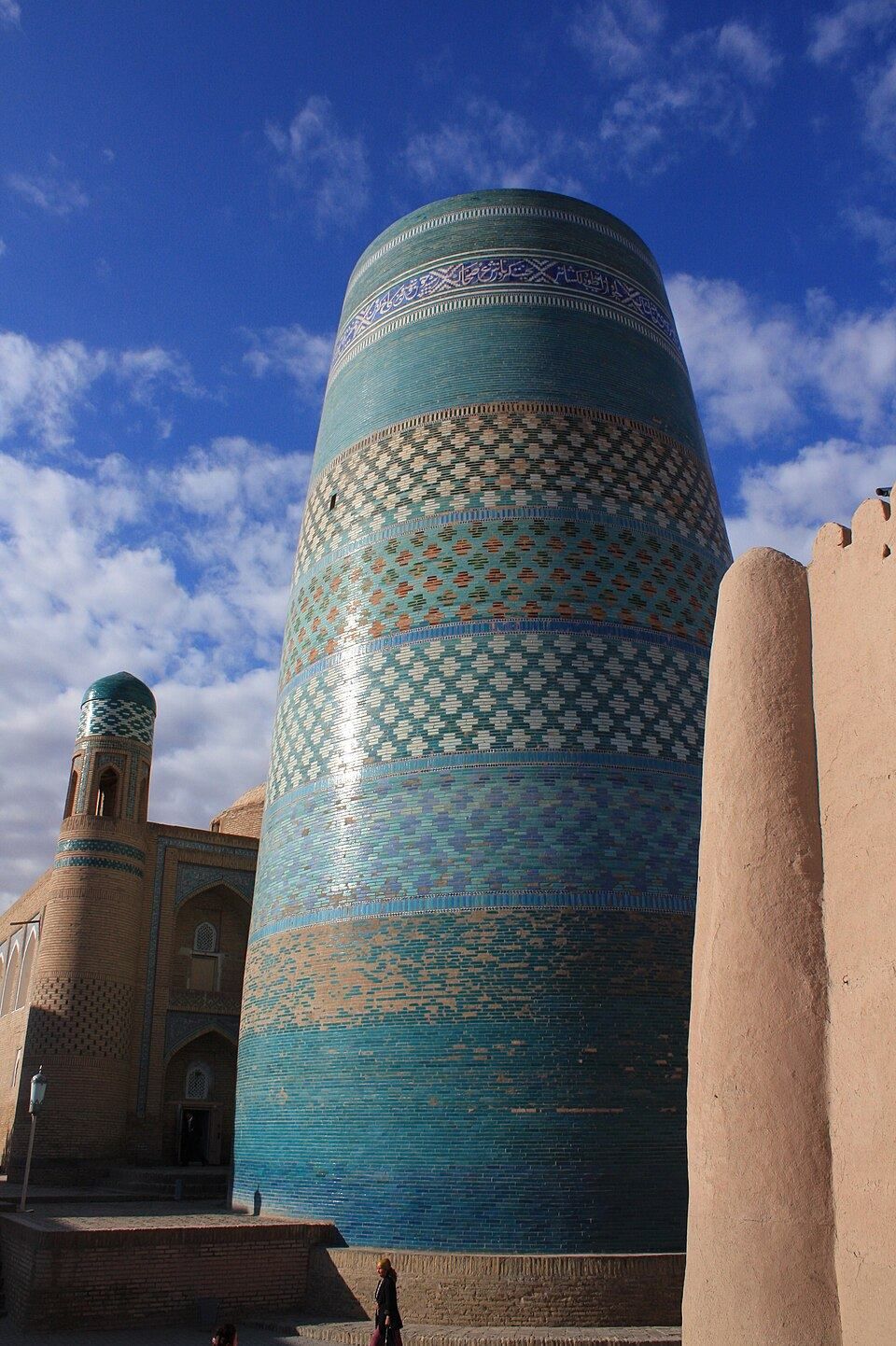
The Juma Mosque has an unusual covered prayer space supported by wooden columns; elements from different periods point to reconstruction and reuse. Madrasas, mausolea and royal palaces were built across several centuries. Kalta Minor, a distinctive nineteenth-century minaret, cannot stand as an illustration of ancient Khiva.
Craft, houses and daily life
Courtyard houses, iwans and carved wooden supports show how climate and local building skills shaped domestic space. Surviving houses matter as much as monumental buildings: they help reconstruct boundaries between private and public life, cooling techniques and the work of local craftsmen.
Monuments nevertheless reflect the resources of those who could commission and preserve them. Palaces alone cannot recover the experiences of women, labourers, rural food suppliers or enslaved people; documents, archaeology and critical reading of chronicles are also needed.
World Heritage and conservation
Itchan Kala joined the World Heritage List in 1990. UNESCO identifies threats to wooden structures, soil salinity and moisture affecting foundations. Conservation should preserve historic materials and the street plan instead of replacing them with plausible-looking replicas.
Tourism brings attention, but a living neighbourhood is not a museum set. The condition of homes, residents' access to services and oversight of new construction are as important to Khiva's survival as care for madrasa façades.
