1920–1924
The Bukharan People's Soviet Republic: A State Experiment, 1920–1924
Created after the abolition of the Bukharan emirate, the republic was not only an instrument of Sovietization. It can also be understood as a short-lived attempt to build a modern national state for Bukhara’s Muslim population and to pursue a sovereign political course.
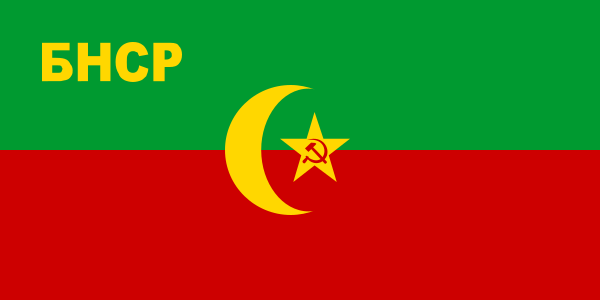
- Proclamation
- 6 October 1920
- Political turning point
- The last emir, ʿĀlem Khan, was overthrown by a Red Army invasion at the end of August 1920
- Armed resistance
- The Basmachi movement continued until 1926; after 1923 it was largely confined to mountainous areas in the east
- Abolition
- October 1924, during the national delimitation of Central Asia
From emirate to republic
After Russia conquered Bukhara in 1868, the khanate became a Russian imperial vassal, although its internal administration long remained nearly unchanged. After 1905 a liberal reform movement developed in Bukhara, met strong opposition from the conservative Islamic clergy, and was suppressed by the emir.
The Bolshevik Revolution of 1917 sharpened the conflict. In March 1918 troops from the Tashkent Soviet attempted to take Bukhara, but withdrew after shelling the city for a day and a half; this formed the immediate background to the subsequent political rupture.
The turning point of 1920
At the end of August 1920 the last emir, ʿĀlem Khan, was overthrown as a result of a Red Army invasion. He fled first to the eastern parts of the country and then, in 1921, to Kabul. This marked the end of Bukhara’s previous political order.
On 6 October 1920 the abolition of the khanate and the proclamation of the Bukharan People’s Soviet Republic were announced. The sources connect its emergence to Soviet control, but its political content calls for a more careful description than the simple labels ‘puppet’ or ‘transitional stage’.
The Young Bukharans and Jadid reform
The Young Bukharans, closely associated with the Jadid reform movement, supplied an important political base for change. Before 1920 they had advocated new-method schools, social renewal, and limits on the emir’s arbitrary authority. They were not a uniform movement: participants held different views about religion, national development, and relations with the Bolsheviks.
The emir’s overthrow allowed some reformers to move from underground activism into government. Yet cooperation with Soviet forces created a lasting tension between their plans to modernize Bukhara and Moscow’s political demands.
Leaders and state institutions
Fayzulla Khojaev became one of the republic’s leading figures as chairman of the Council of People’s Nazirs, its government. Revolutionary governing bodies were established after the events of September 1920, followed by the development of representative and executive institutions.
The All-Bukharan Central Executive Committee was formed in September 1921. Other local reformers, including Usman Khoja, took part in political life. The scope for independent action by Bukharan institutions was nevertheless restricted by the Red Army’s presence, Communist Party influence, and intervention by Soviet representatives.
The constitution and social order
The constitution adopted in 1921 reflected the republic’s transitional character. Unlike more radical models of Soviet government, it permitted certain forms of private property and political participation by broader sections of society. Reformers sought to combine new state institutions with legal and religious understandings familiar to the population.
Formal rights and new offices did not mean that the government’s decisions operated uniformly across the country. Armed conflict, limited administrative capacity, and differences between urban centers and rural districts complicated implementation.
Education, language and cultural reform
Education was a central priority of the Young Bukharan leadership. Abdurauf Fitrat, who served as education nazir, promoted new-method schools, teacher training, curriculum reform, and literacy. These ambitions grew out of Jadid projects developed before the revolution.
The government also sought to train specialists outside the republic and expand publishing. Shortages of money and qualified personnel, ongoing warfare, and uncertain backing from Soviet leaders severely constrained these efforts. Actual achievements fell well short of the reformers’ initial plans.
Economy, foreign relations and the limits of sovereignty
The new authorities faced the task of restoring economic life after regime change and warfare. Budgets, trade, supplies, land relations, and administrative services all required attention. Bukharan leaders also tried to preserve room for independent economic choices.
On 4 March 1921 Bukhara and the Russian Soviet Federative Socialist Republic signed a treaty of alliance. It provided for formal interstate relations and assistance, including the dispatch of specialists and educational materials. Although Bukhara’s independence was formally recognized, economic arrangements, military dependence, and political pressure sharply limited its effective sovereignty.
The meaning of the state experiment
Drawing on Muslim sources—mostly Uzbek and partly Persian/Tajik documents written in Arabic script—Adeeb Khalid reconstructs how the Bukharan government understood its mission and the world around it. In this perspective, the republic appears as an attempt to create a modern national state for Bukhara’s Muslim population.
These documents point to efforts to establish national sovereignty in the political and economic realms, pursue an independent foreign policy, and form a national memory. On this reading, the republic’s intellectual and bureaucratic foundations owed more to Muslim modernist discourses of the late Ottoman Empire than to the Russian Revolution.
Resistance and the end
Armed resistance to the Soviets, known as the Basmachi movement, continued until 1926; after 1923 it was largely limited to mountainous areas in the east. By the end of 1923, political purges organized by representatives of Moscow had brought the government of Bukhara fully under Russian control.
In October 1924 the republic was dismantled under the Soviet plan for the national delimitation of Central Asia; most of its territory was included in the newly formed Uzbek Soviet Socialist Republic. Losing its status as a capital seriously affected Bukhara: the 1926 census recorded only 41,839 inhabitants in the city.
National delimitation and the changes of 1924
In the republic’s final phase, Soviet authorities prepared the national-territorial delimitation of Central Asia. This redrew older administrative areas in light of national projects, ethnographic classifications, and political decisions. The intermingling of communities made drawing new boundaries particularly difficult.
In September 1924 Bukhara was reconstituted as a Soviet socialist republic, but that status was brief. The establishment of new national-territorial units followed in October: most former Bukharan territory was assigned to the Uzbek and Turkmen Soviet republics, while parts of the east entered the Tajik autonomous republic within the Uzbek SSR.
Historical significance
The experience of 1920–1924 cannot be reduced either to straightforward Sovietization or to a fully independent national project. Local reformers attempted to build new schools, institutions, and forms of political belonging while working under military and institutional constraints.
Alongside decisions made in Moscow, sources written in Bukhara’s local languages are essential for recovering the aims and disagreements of contemporaries. The outcomes of reform, local responses to the new government, and the forms of armed resistance also require historians to distinguish leadership aspirations from everyday realities.
Sources
- Encyclopaedia Iranica, Bukhara iii
- Adeeb Khalid, The Bukharan People's Soviet Republic in the Light of Muslim Sources
- Britannica, Russian and Soviet rule in Uzbekistan
- Encyclopaedia Iranica, Jadidism (Keith Hitchins)
- Adeeb Khalid, Making Uzbekistan, chapter 4: The Muslim Republic of Bukhara (2015)
- Treaty of Alliance between the RSFSR and the Bukharan Soviet Republic, 4 March 1921 (historical document)
- M. Allanazarov, All-Bukharan Central Executive Committee and the Activity of National Cadres
- Yuri Bregel, An Historical Atlas of Central Asia