1st millennium BCE — present
Bukhara: city and historic landscape
Bukhara links an ancient oasis and Sogdian past with Islamic scholarship, trade and an exceptional medieval urban ensemble.
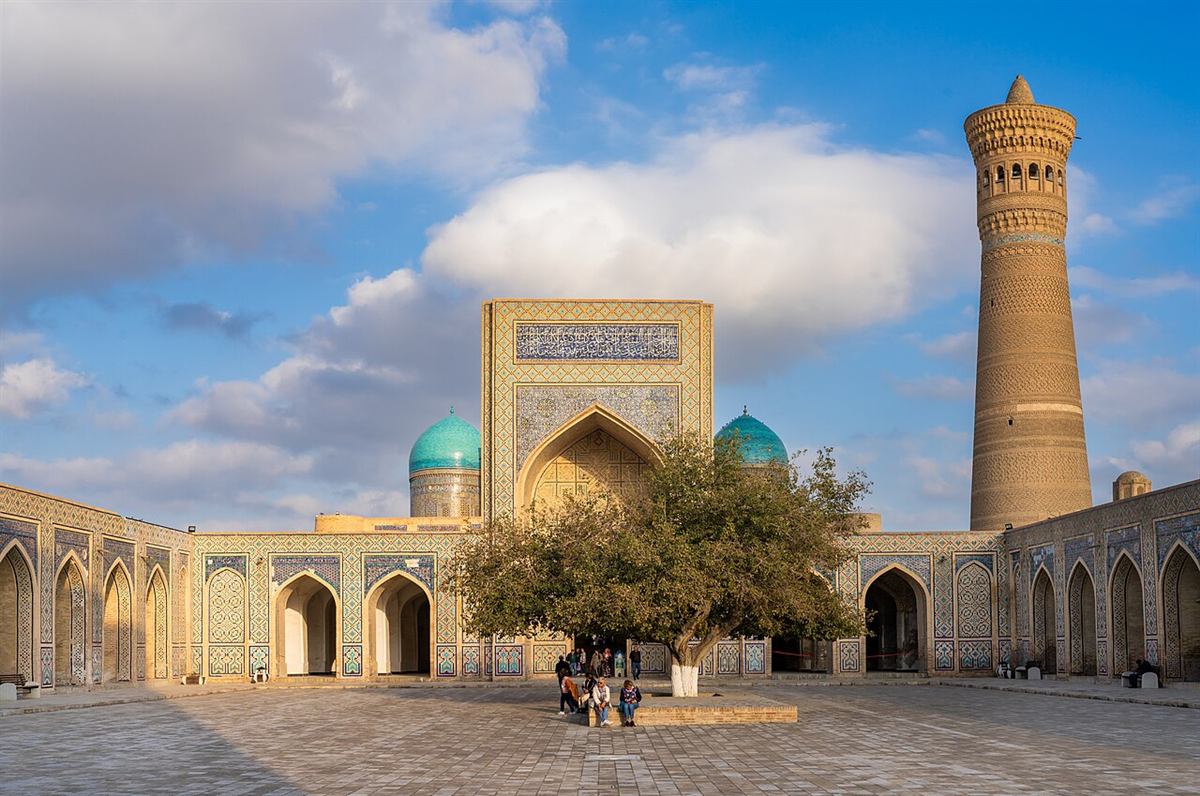
- Age
- More than two thousand years
- Status
- UNESCO World Heritage since 1993
- Monuments
- Samanid Mausoleum, Po-i-Kalyan, Lyabi-Hauz, madrasas
Oasis and early city
The Bukhara oasis developed as a centre of farming and exchange on Sogdiana’s western edge. Archaeology demonstrates a long history of settlement, although the exact foundation date and the name’s origin remain debated.
The modern city cannot be projected unchanged into antiquity: its core, walls, canals and suburbs shifted with waterways, trade routes and political authority.
Islamic city and scholarship
Islamisation after the Arab conquest was gradual. Under the Samanids, Bukhara became a major political and intellectual centre associated with theology, literature, book culture and education.
The Samanid Mausoleum is among the most important surviving monuments of early Islamic architecture in Central Asia. Its intricate brickwork is both structural and decorative.
Urban fabric and monuments
Bukhara’s historical value lies not only in individual buildings but in the relationships among streets, trading domes, mosques, madrasas, pools and residential quarters. Much of the visible ensemble dates from the sixteenth and seventeenth centuries.
Po-i-Kalyan, Lyabi-Hauz and the trading domes show how religious, civic and commercial functions formed one urban system.
Conserving a living city
UNESCO describes Bukhara’s historic centre as one of the most complete examples of a medieval Central Asian city. Its authenticity depends on scale, layout and traditional surroundings as well as façades.
Restoration, tourism infrastructure and new construction require public documentation and professional oversight: excessive reconstruction can erase the historical layers it is meant to protect.