1898, the Russian Empire’s colonial period in Turkestan
The Andijan Uprising of 1898
The armed rising near Andijan on 30 May 1898, led by Dukchi Ishan, grew from the economic, social, and religious consequences of Russian rule. Its defeat brought severe punishments and a further expansion of colonial administrative power.
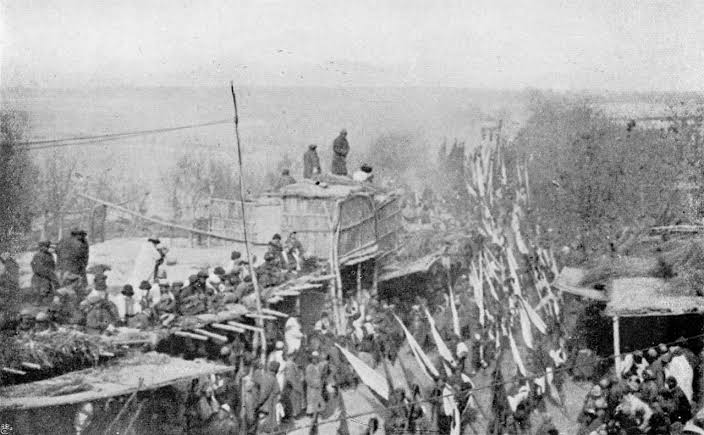
- Date
- 30 May 1898 (18 May Old Style), the ninth day of Muharram
- Location
- The outskirts of Andijan; planned attacks in Margelan and Osh failed
- Leader
- The Naqshbandi Sufi shaykh Dukchi Ishan, Muhammad Ali Madali (c. 1856–1898)
- Outcome
- Eighteen participants were executed; 365 of 546 detainees received imprisonment, hard labor, or exile
Event and battle
On the night of 30 May 1898, about two thousand poorly armed men attacked the Russian 4th and 5th Companies on the outskirts of Andijan. The movement was led by the Naqshbandi Sufi shaykh Dukchi Ishan, also known as Muhammad Ali Madali.
The battle ended after roughly fifteen minutes: 22 Russian soldiers were killed and 18 wounded. Officials and Russian civilians also suffered casualties. In Margelan the soldiers were alert, while in Osh the garrison had been warned, and the other planned attacks failed.
Colonial context and causes
The uprising belongs first of all to the context of the tsarist annexation of the Khanate of Kokand in 1876 and the resulting economic, social, and religious disintegration of the local population. Many peasants lost land, while local traders and craftsmen could not compete with Russian colonizers and merchants privileged by the new fiscal system.
The expansion of cotton cultivation and the Russian government’s new property policy added to the strain. Some Russian regulations conflicted with local norms: the opening of Russian-native schools, naming the tsar in the Friday sermon, and deleting words for ‘infidels’ from reprinted Qur’ans were perceived as affronts.
Leader and participants
Dukchi Ishan was born in the village of Chimion, studied basic religion in Bukhara and Samarkand, and became a Sufi master after his teacher Sultan Khan Tura died in 1882. At Mingtepe he established a khanqah that attracted people seeking instruction, blessings, healing, and counsel; his followers came from almost every ethnic group and social stratum in the Ferghana Valley.
The rebels included Kyrgyz, Uzbek peasants, former officials of the Kokand khanate, religious dignitaries, and local members of the Russian administration. The article reports that semi-nomadic Kyrgyz made up about half of the participants. Their swords, knives, and staves were no match for regular military arms.
Preparation and defeat
At first Dukchi Ishan apparently did not favor force: in a work composed around 1893–94 he called for religious and moral reform and declared his pen to be his weapon. Around 1895–96, however, he seems to have accepted rebellion as the only way to overcome moral decline under Russian rule.
He sent letters to clan elders and other influential figures in the valley calling for a ghazwa or jihad. He fixed the attack for 9 Muharram, the eve of Ashura; the day before, about five hundred followers nominated him ‘Khan’. The response remained limited, and preparation and weapons were inadequate.
Repression and historical memory
The Russian administration treated the uprising as a religious war and imposed severe punishments. Eighteen participants, including Dukchi Ishan, were publicly executed in Andijan; of the 546 people arrested, 365 were jailed, sentenced to hard labor, or mainly exiled to Siberia, while 163 were released.
Afterward the governor-general’s authority was expanded, including the power to remove local judges. Interpretations changed over time: Soviet historiography called the event ‘reactionary’, ‘feudal-nationalist’, or a national-liberation struggle; in independent Uzbekistan it is officially regarded as a struggle for Turkestan’s independence and religious, sociopolitical, and national freedom. A document linking Dukchi Ishan to the Ottoman sultan was judged a forgery and should not be treated as established fact.
The Ferghana region after 1876
Following the abolition of the Khanate of Kokand in 1876, the Ferghana Valley was incorporated into the Russian Empire’s Turkestan Governor-Generalship. Local political institutions lost their former roles, administrative and judicial practices changed, and older rivalries between settled and semi-nomadic communities remained relevant.
Commercial agriculture, particularly cotton production, increased the exposure of some households to market pressures and imperial administration. Historians consider disputes over land, taxation, religion, and political authority as interconnected factors. None of these provides a single explanation for the motives of every participant.
Mingtepe and Dukchi Ishan’s influence
After the death of his teacher Sultan Khan Tura in 1882, Muhammad Ali, known as Dukchi Ishan, became an influential Naqshbandi Sufi master. His followers developed a substantial khanqah complex at Mingtepe, about 35 kilometers southeast of Andijan, where religious instruction and meetings took place.
Historical accounts discussed in Encyclopaedia Iranica describe hundreds of visitors seeking counsel, blessings, and healing. His network extended beyond agricultural settlements to Kyrgyz communities around Akterek near Osh. Estimates of daily visitors are drawn from historical testimony rather than a modern statistical census.
The text Ibrat al-ghafilin and changing attitudes
Dukchi Ishan composed a Turkic-language work known as Ibrat al-ghafilin (Admonition to the Heedless), dated approximately 1893–1894, which emphasized religious morality and reform. Scholars note his metaphor of the pen as his weapon; the work itself was not a straightforward call to launch an armed attack.
By the mid-1890s he appears to have moved toward acceptance of armed resistance. This reconstruction draws on writings, contemporary testimony, and investigation records, and should not be mistaken for direct access to every participant’s intentions. Encyclopaedia Iranica notes three manuscripts of the work at the Biruni Institute of Oriental Studies in Tashkent.
Mobilization and limited support
Appeals were sent to clan elders and influential figures across the Ferghana Valley. Responses varied: some rejected participation, while others urged delay until better weapons and preparation were available. The rebellion therefore cannot be represented as a unanimous mobilization of the entire region.
On the eve of the attack, approximately five hundred followers proclaimed Dukchi Ishan khan. Historians regard this as a possible sign that restoration of khanate authority remained an aspiration, although the religious and political aims of participants may have differed. Coordinated attacks in more than one town were planned but did not materialize.
The night of the attack and its failure
During the night of 17–18 May in the Julian calendar (29–30 May in the Gregorian calendar), rebels attacked Russian military units near Andijan. Encyclopaedia Iranica reports a battle lasting approximately fifteen minutes, with 22 Russian soldiers killed and 18 wounded; these figures derive from the historical works cited in that entry.
Most rebels lacked weapons suited to sustained fighting against regular troops. Plans at Margelan and Osh failed when garrisons were alerted or prepared. The limited coordination, inadequate arms, uneven support, and rapid imperial response help explain the defeat.
Investigation, punishments, and administrative response
Arrests, trials, executions, imprisonment, and exile followed the rebellion. Encyclopaedia Iranica records 546 arrested people: 18 were executed, 365 received other punishments, and 163 were released. These numbers account for the total when executions are treated separately from the remaining 528 detainees.
Imperial officials primarily treated the uprising as dangerous religious mobilization. In its aftermath the Turkestan governor-general gained wider administrative powers, including over the removal of local judges. Claims about confiscations, destruction, and individual sentences require careful checking against separate archival records.
Sources, photographs, and historiographical debates
The uprising can be reconstructed through imperial reports, investigation files, local narratives, memoirs, and modern scholarship. Official records can help establish chronology but also reflect the vocabulary and interests of the colonial administration.
A 2022 study by Yu. I. Maksimov and A. B. Mambetova examines late nineteenth- and early twentieth-century photographs held by the Earth Science Museum at Moscow State University. Publications by E. A. Avazov (2021) and M. M. Soliev (2021) discuss divergent pre-revolutionary and Soviet interpretations. Together these works help distinguish documented events from later political assessments.
Historical significance and interpretive limits
The Andijan Uprising was among the notable armed challenges to Russian rule in late nineteenth-century Turkestan. It revealed tensions between imperial administration and segments of Ferghana society, and the ability of a religious leader to mobilize people across social and ethnic lines.
Describing it as either an exclusively religious revolt or a uniformly national movement would oversimplify the evidence. Scholars examine anti-colonial, religious, social, and political motives whose relative importance varied across groups. It must be distinguished from the separate Central Asian revolt of 1916.
Sources
- Anke von Kügelgen, Encyclopaedia Iranica — Andijan Uprising
- Encyclopaedia Iranica — Andejan (historical context)
- Nurefşan Çetintaş (2022), Ankara Hacı Bayram Veli University journal
- E. A. Avazov (2021), pre-revolutionary historiography
- M. M. Soliev (2021), Soviet historiography
- N. Ahatov (2024), Andijan uprising historiography
- Yu. I. Maksimov and A. B. Mambetova (2022), photographic archive study