From the 4th–3rd centuries BCE to the early 13th century, with later phases of restoration
Ancient Termez: A Northern Bactrian City and Cultural Crossroads
Ancient Termez on the Amu Darya is an archaeological city whose evidence spans Hellenistic, Kushan and Islamic periods. Qoratepa and Fayaztepa illuminate its Buddhist heritage, while later layers reveal urban life in Northern Tokharistan.
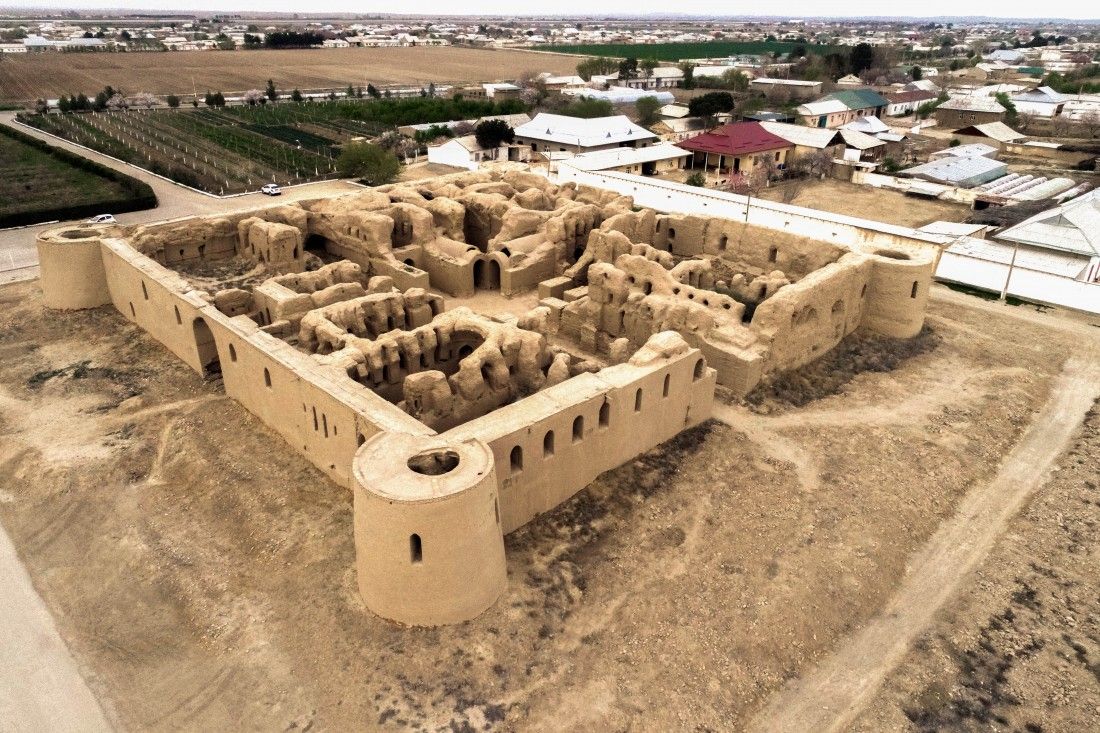
- Location
- Ancient Termez stood on a right branch of the Amu Darya, about 5 km north-west of modern Termez.
- Emergence
- According to the UNESCO dossier, the settlement took shape in the 4th–3rd centuries BCE.
- Kushan period
- Tarmit was a major administrative and ideological centre of Northern Bactria, with the Buddhist complexes of Fayaztepa and Qoratepa.
- Later fate
- The city flourished from the 9th–10th centuries to the early 13th century and was destroyed by the Mongols in 1220.
Location and emergence
Ancient Termez, also known as Old Termez in archaeological descriptions, stood on a right branch of the Amu Darya. UNESCO places it 5 km north-west of modern Termez and gives the ancient area as about 500 hectares.
The settlement is dated to the 4th–3rd centuries BCE. UNESCO describes a citadel, two shahr-istans and a suburb, or rabat, separated by fortifications; it connects the settlement with Demetriya in the 3rd–2nd centuries BCE, but that identification should be treated cautiously.
Hellenistic and Kushan period
After Alexander’s campaigns, Hellenistic and local traditions interacted in Bactria. Iranica describes the Greco-Bactrian kingdom of 250–140 BCE as an important setting for this synthesis; the Kushan period later marked a high point of urban civilization in Northern Bactria.
In the Kushan period, Tarmit was an administrative and ideological centre. Archaeological descriptions place it within a Northern Bactrian urban system where craft, irrigated production and long-distance exchange developed; these conclusions are drawn from layers, buildings and finds.
Buddhist centre
The Qoratepa and Fayaztepa complexes near Old Termez are identified as Buddhist monasteries. UNESCO describes Qoratepa as a complex with cave prayer rooms and monastic cells, while Fayaztepa is identified as a sangharama-type institution with a courtyard, ritual buildings and a detached stupa.
Iranica reports that the Chinese pilgrim Xuanzang counted about twelve monasteries and roughly one thousand monks in Ta-mi, that is, Termez, in the first quarter of the seventh century. This written testimony should be read alongside archaeology rather than treated as a precise inventory or automatic dating of every surviving complex.
Islamic period and destruction
Termez entered the Islamic political sphere at the end of the seventh century. In later centuries it was associated with the Ghaznavid, Seljuk, Karakhanid and Khwarazmshah states; the museum account presents the period from the late ninth to the early thirteenth century as a time of developed urbanism and craft in Termez and Chaghaniyan.
In 1220 the troops of Genghis Khan destroyed the city after a two-day siege. Termez was later restored, but UNESCO shows that the history of the ancient centre is now read chiefly through archaeological remains and monuments preserved across the site.
Research and heritage
The Ancient Termez complex includes Qoratepa, Fayaztepa, the Zurmala stupa, Qirq-Qiz, Hakim at-Termiziy, Sultan-Saodat, Kokildor Khonaqo and other monuments. Excavations have revealed Buddhist monasteries, the palace of the Termiz shahs, a mosque, metalworkers’ and potters’ quarters, walls and domestic-economic complexes.
The National Centre of Archaeology of the Academy of Sciences of Uzbekistan identifies the origins and economic development of ancient cities, including Termez, as well as the study of ancient Tokharistan culture and Buddhist monuments among its research fields. Ancient Termez is therefore reconstructed by comparing written testimony, archaeological strata and architectural remains.
A crossroads of river and overland routes
Termez stood beside the Amu Darya, the ancient Oxus, connecting communities on both banks of the river, areas of present-day Afghanistan, and the cities of Transoxiana. Its position mattered not only to long-distance caravans but also to river crossings, local exchange, and agriculture in the Surkhan Darya basin.
It is misleading to imagine a single unchanging Silk Road: the network of routes shifted with political and economic conditions. Termez was one of its nodes, where merchandise, artistic forms, and religious ideas circulated.
The citadel, fortifications, and archaeological chronology
Old Termez is a multilayered archaeological city. Its citadel, fortified urban districts, and suburbs were built and altered in different periods; dates for individual walls and buildings depend on stratigraphy, pottery, and other archaeological evidence.
At the fortified enclosure of Tchingiz Tepe, researchers documented changing uses: an early defensive function, Buddhist worship in the Kushan period, and renewed military use under the Kushano-Sasanians. Stratigraphic analysis and radiocarbon dating show why the site cannot be reduced to one foundation date.
Kushan Bactria and cultural diversity
During the early centuries CE, northern Bactria belonged to the wider Kushan world. Urban and irrigation expansion and craft production accompanied the spread of Buddhism and the continuation of other local religious traditions. The Bactrian language was written using an alphabet of Greek origin.
Archaeology at Termez and neighbouring sites reveals artistic and technological links across regions. Finds at Ayrtam, including a Buddhist sculptural frieze, illuminate local artistic expressions shaped by contacts with Indian and Hellenistic traditions.
Fayaztepa, Qoratepa, and the Zurmala stupa
Qoratepa combined surface courtyards and subterranean rooms in complexes built in different phases. Fayaztepa was a monastic ensemble with sacred and residential areas; sculptures and architectural remains help researchers reconstruct practices and the organization of its community.
The Zurmala stupa is a large Buddhist monument near Termez, generally assigned to the early centuries CE in archaeological interpretations. These monuments should not be treated as strictly contemporary: each has its own construction, occupation, and abandonment history.
From a Buddhist centre to an Islamic city
The religious history of Termez was not an instantaneous replacement of one tradition by another. Seventh-century written accounts indicate an important Buddhist presence, whereas subsequent centuries saw the consolidation of Islamic institutions. Archaeology is essential for dating the decline of individual monasteries.
In the ninth to twelfth centuries Termez was a centre of Islamic learning. The scholar and Sufi al-Hakim al-Tirmidhi, who wrote about spiritual discipline and sainthood, was associated with the city; his memorial complex became an important landmark of its religious history.
Medieval crafts, markets, and urban life
Under the Samanids and successive rulers, Termez developed as a craft and trading centre. Excavations have identified metalworking and pottery facilities, residential quarters, and fortifications. Ceramics, including glazed wares from the Islamic period, provide evidence for technology, consumption, and exchange.
The medieval city comprised fortified cores and surrounding neighbourhoods. Its fortunes depended on river communications, political control, and the surrounding agricultural economy; prosperity from the ninth to early thirteenth century did not exclude conflict and rebuilding.
Mongol conquest, later settlement, and conservation
The destruction of 1220 marked a rupture for the ancient urban core, but did not end settlement throughout the region. People and urban functions later shifted, while some sacred places and architectural ensembles continued to be used and rebuilt.
Termez requires careful conservation: mudbrick monuments are particularly vulnerable to water and erosion. Ancient Termez appears on Uzbekistan’s UNESCO World Heritage tentative lists, which should not be confused with inscription of the site on the World Heritage List itself.
Sources
- UNESCO — Silk Roads Sites in Uzbekistan
- Encyclopaedia Iranica — Buddhism IV
- Termez Archaeological Museum article
- National Centre of Archaeology of Uzbekistan
- UNESCO World Heritage Centre — Ancient Termiz (Tentative List)
- Encyclopaedia Iranica — Bactria i. Pre-Islamic Period
- Encyclopaedia Iranica — Archaeology v. Pre-Islamic Central Asia
- Encyclopaedia Iranica — Excavations iii. In Central Asia
- Martínez Ferreras et al. (2014) — The Enclosure of Tchingiz-Tepe, Iranica Antiqua
- Getty Conservation Institute — Conservation of Ancient Sites on the Silk Road
- The Buddhist occupation of Tchingiz Tepe through ceramic contexts