Neolithic — 8th century CE
Ancient Khorezm: river, fortresses and state
Khorezm’s history developed in the shifting delta of the Amu Darya. Canals, fortified settlements, palaces, archives and coins document an independent culture along the river’s lower course.
- Region
- Lower Amu Darya and its ancient deltas
- Key sites
- Kyuzeli Gyr, Koi Krylgan Kala, Toprak Kala, Ayaz Kala
- Evidence
- Archaeology, Chorasmian documents, coins, Old Persian and classical texts
The delta as a historical environment
Khorezm developed along the lower Amu Darya, where the river sustained farming but repeatedly changed the conditions of life. Channels shifted, canals silted up, some parts of the delta became irrigable and others lost water. Settlement history must therefore be read alongside palaeogeography and the history of irrigation.
The region’s name occurs in the Avesta and Old Persian inscriptions. A written name, however, does not define an unchanging territory across every period. The archaeological cultures of the ancient delta, the political province of the Achaemenid age and medieval Khorezm are connected but not identical.
From Keltiminar sites to an oasis
Around the turn of the fourth to third millennium BCE, communities of the Keltiminar tradition lived in the Aral region. They used wetland resources, hunted, fished and made pottery. Later Bronze Age cultures reveal connections both to farming regions in the south and to societies of the steppe.
The emergence of large-scale irrigated agriculture was not one event. Building and maintaining canals required collective labour, but irrigation alone does not prove a centralised state. The scale of administration must be tested through settlement plans, storage, fortifications and administrative evidence.
Canals and fortified centres
In the sixth and fifth centuries BCE, large canals tens of kilometres long, mud-brick architecture and the potter’s wheel became prominent. Archaeologists have recorded hundreds of archaic-period settlements. Kyuzeli Gyr included fortifications, housing, storage and structures interpreted as a palace and ceremonial complex.
Khorezm’s fortresses were not merely military structures. They helped control population, reserves, desert routes and parts of the irrigation network. Different qalas were built, rebuilt and abandoned in different centuries, so romantic collective labels cannot replace precise chronology.
Between Achaemenid and independent power
Chorasmia appears among the lands of Darius I in the Bisitun inscription. Archaeological and written evidence connects the region to the Achaemenid system, although the character of dependence may have changed. By the fourth century BCE, Khorezm probably stood outside direct Persian control.
The hypothesis of a pre-Achaemenid “Greater Chorasmia” extending towards Merv and Herat was influential in twentieth-century scholarship, but it is not an established fact. It should be presented as a scholarly reconstruction rather than an uncontested map of an ancient state.
Toprak Kala, archives and coinage
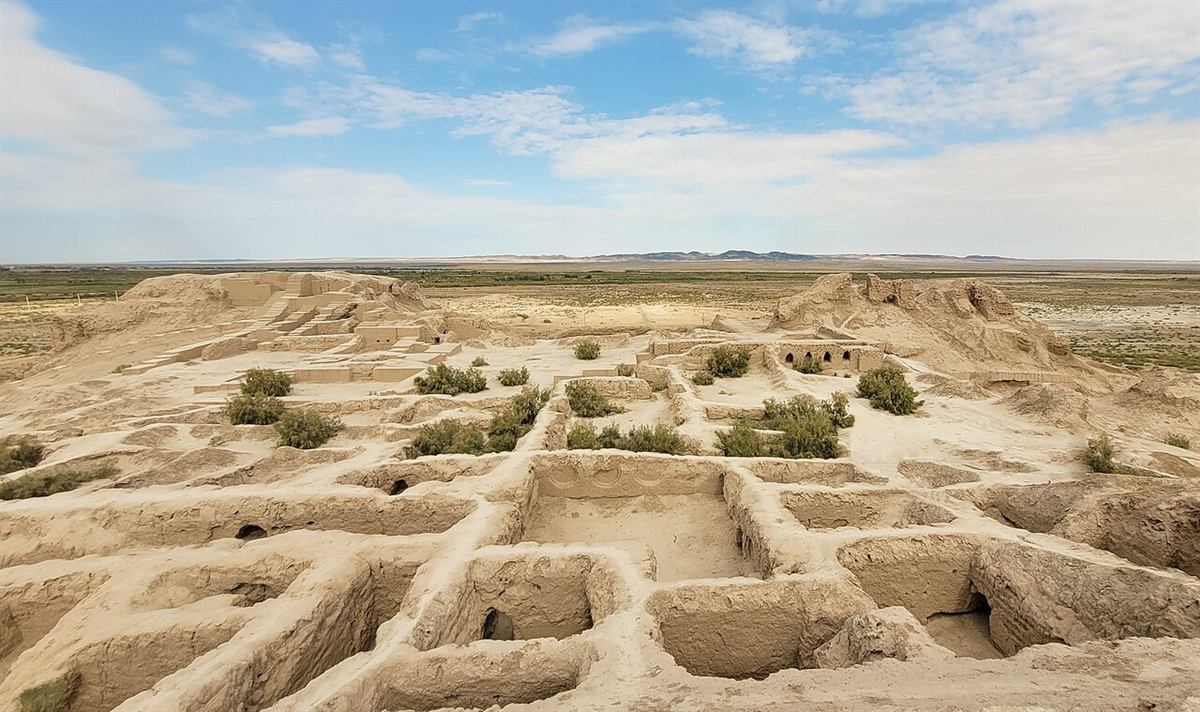
Toprak Kala is especially important for its palace complex, murals, sculpture and documents in the Chorasmian language. Administrative tablets include lists of people and household designations, revealing practices of government behind the monumental architecture.
Chorasmian coins were issued over many centuries. Legends, portraits and symbols help establish sequences of rulers, but a coin image is not a photographic portrait. Numismatics is strongest when combined with stratigraphy, documents and the study of hoards.
Heritage and conservation
Toprak Kala, Ayaz Kala, Koi Krylgan Kala and other sites form an archaeological landscape, not a set of isolated stage sets. Mud-brick architecture is particularly vulnerable to rain, wind, groundwater, uncontrolled visitor movement and inappropriate reconstruction.
Conservation requires condition recording, drainage, visitor management and publication of restoration decisions. Inclusion of the “Desert Castles of Ancient Khorezm” on UNESCO’s Tentative List recognises the complex’s value but does not itself constitute World Heritage status.